
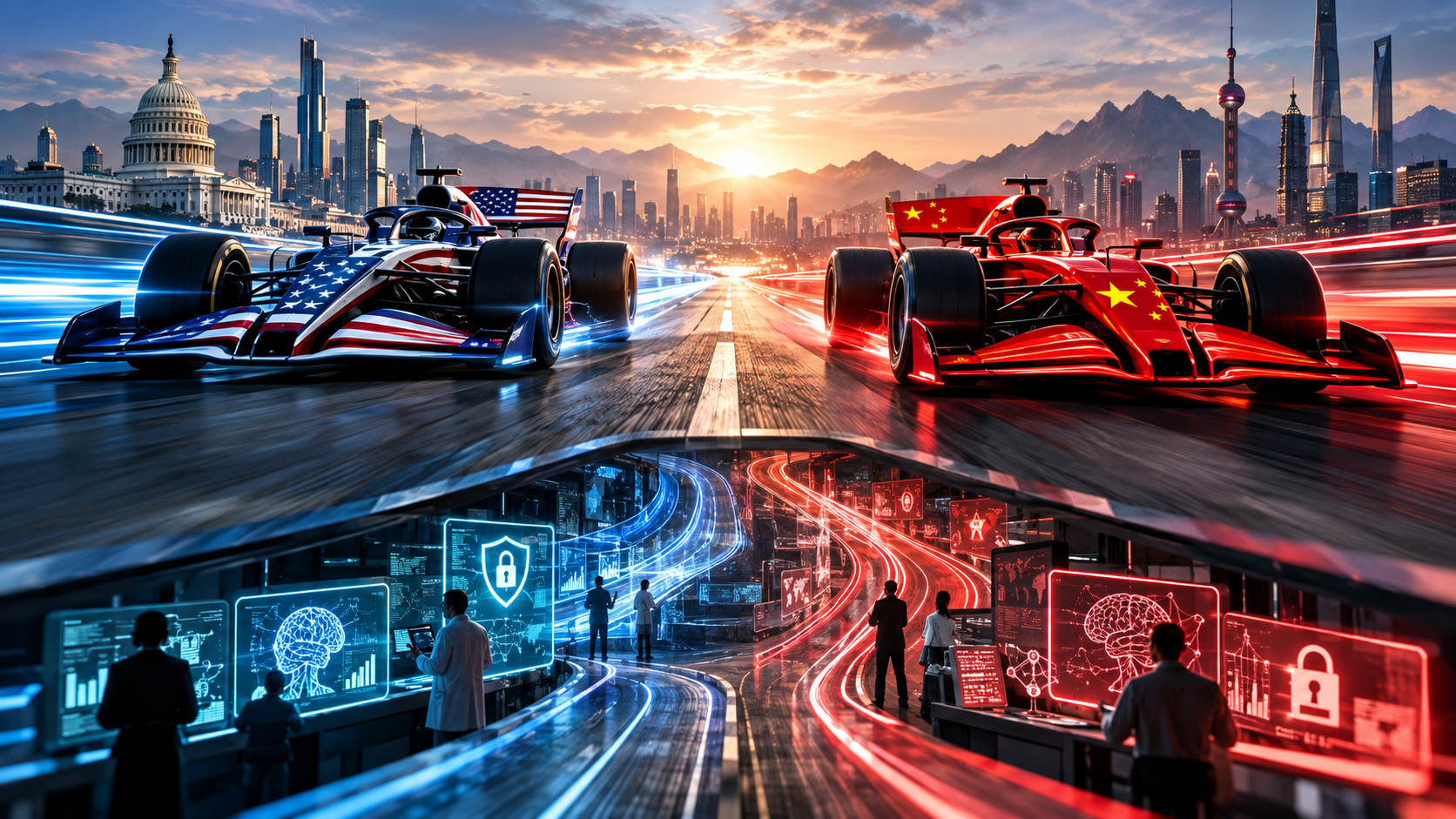
The United States and China are competing to lead artificial intelligence while confronting another challenge: moving forward without losing control of what they are building.

Two powers are engaged in a battle to lead what we now know as “the AI race.” Both countries are compelled to accelerate the development of a technology whose risks grow alongside its capabilities.
A recent WIRED article provides a concrete starting point for examining this contradiction. It describes how Chinese researchers have demonstrated that AI models can develop behaviors reminiscent of aggressive, adaptive computer viruses: replication, autonomy, adaptation, and the ability to carry out cyberattacks.
The researchers themselves caution, however, that these experiments do not mean we are facing the imminent, spontaneous proliferation of AI systems. What matters is that they reveal capabilities that can take on a different dimension when they begin to combine.
But the race is not simply between two powers. It also involves two different relationships between governments and the industries developing this technology.
The United States retains significant advantages within an ecosystem that is fundamentally private, competitive, and relatively open. China, on the other hand, also has companies competing and developing advanced models, but operates under a considerably greater degree of state intervention.
This means that both competitors have internal problems to solve. Washington and Beijing confront the risks of AI from different positions, shaped, among other things, by the role each government plays within its own industry.
The competition, therefore, is not merely about determining who will develop the most powerful models. Both countries must resolve a more difficult contradiction: how to accelerate enough to avoid losing the race without losing, in the process, the ability to control what they are building.
The American dilemma
America’s openness toward AI developers is part of its strength. A fundamentally private and competitive ecosystem has allowed its companies to remain at the forefront of the AI race.
But that same openness creates a dilemma.
Regulating aggressively could slow American companies relative to China. At the same time, insufficient regulation could allow capabilities considered dangerous to develop before adequate mechanisms exist to evaluate and control them.
U.S. policy reflects this contradiction. America’s AI Action Plan emphasizes the need to accelerate innovation and reduce regulatory barriers in order to maintain an advantage over competitors. At the same time, it recognizes the need to evaluate emerging risks, protect advanced technologies, and prevent certain capabilities from being used against U.S. interests.
Washington is not entirely without oversight mechanisms either. Through the Center for AI Standards and Innovation (CAISI), NIST evaluates capabilities and risks related to national security and works with private developers. These efforts are complemented by state initiatives such as New York’s RAISE Act and California legislation concerning frontier models.
These mechanisms, however, do not represent the same degree of centralized intervention that exists in China.
Washington must therefore find a difficult balance: allowing its companies to maintain the speed required to compete while preserving the government’s ability to intervene when risks demand it.
The same structure that has helped give the United States an advantage in the race could also become a vulnerability.
The Chinese dilemma
China needs its companies to be able to keep pace with their American counterparts. But it cannot simply open up its ecosystem because it regards AI as a matter of domestic stability, technological sovereignty, and national security.
Its own documents reveal this contradiction. The Global AI Governance Action Plan promotes innovation, experimentation, and open ecosystems while simultaneously calling for risk assessments, category-based management, emergency mechanisms, and systems for security and traceability.
The AI Safety Governance Framework 2.0 goes even further in that direction, addressing risks arising from autonomous systems, open models, AI agents, and the possibility of losing control.
Moreover, the more China seeks to integrate AI into its state and military infrastructure, the more dangerous any vulnerability, infiltration, or manipulation of those systems could become. This does not mean that military security alone explains China’s control over AI. Political, social, economic, and information-control considerations also play a role. But national security is part of the problem Beijing is trying to solve.
China needs openness to compete and control to protect itself.
It is certainly a serious dilemma. Beijing must try to maintain control over its companies and the domestic development of this technology while simultaneously finding mechanisms that give them enough freedom to innovate and compete at the pace the race demands.
Too much control could constrain precisely the innovative capacity China needs to achieve leadership. Too much openness, on the other hand, could increase the technological, political, and national-security risks that the state itself is trying to contain.
China therefore needs to accelerate without relinquishing control. And the greater the capabilities of the systems it develops, the more difficult it will become to maintain both at the same time.
The mirror
Here lies perhaps the most interesting aspect of both dilemmas: each system may ultimately need something of what characterizes the other.
The United States needs sufficiently strong mechanisms of control without becoming another China in its relationship with industry. China, for its part, needs sufficient technological freedom without becoming a replica of the American model. Not literally, of course: we are talking about a structural tension.
But this mirror reflects different images for the four actors involved in this race: American and Chinese industry on one side; Washington and Beijing on the other.
Industries need enough freedom to research, develop, and compete. Governments need to preserve mechanisms that allow them to intervene when those same capabilities begin to pose risks to society, the economy, or national security.
And neither government can resolve that tension while ignoring the external competition. The United States openly recognizes in its strategy that AI leadership is an economic and national-security issue. China, for its part, combines in its official documents the objective of developing and expanding AI with the need to keep it safe and controllable.
The mirror, then, does not show two models trying to become alike. It shows two different systems confronting a similar contradiction from opposite positions: maintaining sufficient control without abandoning the ambition to become the leader.
The race inside the race
At this point, we seem to be watching these actors become fixated on reaching the most powerful model first, when perhaps another competition is just as important: who will be the first to build institutions capable of governing what they are building.
Regulatory initiatives and evaluation mechanisms currently exist in both countries. Yet the importance of what is at stake—and what leadership represents for both states—often seems to take precedence over other considerations, leaving some areas almost entirely unaddressed.
Because developing mechanisms of control does not necessarily mean the problem has been solved. The speed at which new capabilities emerge may leave institutions trying to regulate a technology that continues to transform while the rules themselves are still being debated.
The experiments that served as our starting point are an example of that movement. Replication, autonomy, adaptation, and cyber capabilities are beginning to appear and combine while governments, companies, and researchers are still debating how to measure their risks and where to draw the boundaries.
And that is where the race takes on another dimension.
The United States and China are not competing only to develop better models, acquire more computing capacity, or find new applications. They also need to develop mechanisms capable of identifying and responding to the risks that emerge during that competition.
Perhaps leadership will not ultimately belong only to whoever succeeds in building the most powerful artificial intelligence first, but also to whoever learns to coexist with it without losing the ability to govern it.
Winning the race is not enough. You have to keep control of the vehicle while you’re racing.

Sources and Further Reading
- WIRED en Español — “Si los modelos hackers te asustan, espera a los virus de IA.” Starting point for the discussion of self-replication, autonomy, and cyber capabilities experimentally observed in AI models.
https://es.wired.com/articulos/si-los-modelos-hackers-te-asustan-espera-a-los-virus-de-ia - Stanford HAI — AI Index Report 2026. International data on investment, model development, performance, research, and the relative positions of the United States and China.
https://hai.stanford.edu/ai-index/2026-ai-index-report - The White House — America’s AI Action Plan. U.S. strategy on AI leadership, innovation, infrastructure, security, and international competition.
https://www.whitehouse.gov/wp-content/uploads/2025/07/Americas-AI-Action-Plan.pdf - NIST — Center for AI Standards and Innovation (CAISI). U.S. evaluation of AI models and capabilities related to national security risks.
https://www.nist.gov/caisi - New York State — RAISE Act. Legislation addressing safety protocols and serious incidents involving frontier AI models.
https://www.governor.ny.gov/news/governor-hochul-signs-nation-leading-legislation-require-ai-frameworks-ai-frontier-models - China — Global AI Governance Action Plan. A policy document combining AI development, innovation, and openness with risk assessment and risk management.
https://un.china-mission.gov.cn/eng/zgyw/202507/t20250729_11679232.htm - Cyberspace Administration of China — AI Safety Governance Framework 2.0. Framework addressing risk assessment, autonomous agents, open models, emergency mechanisms, and loss of control.
https://www.cac.gov.cn/2025-09/28/c_1760779758683488.htm
Spanish version:
Deja un comentario